Original concept / Industrial design / Hydrostatics
Design a sampling platform around competing constraints.
The study compares three selected configurations: instruments, samples on the original hull, and samples on the revised hull. It balances 40-litre sampling capacity, a transport width of no more than 950 mm, flotation reserve and the assumed masses of modules and liquids.
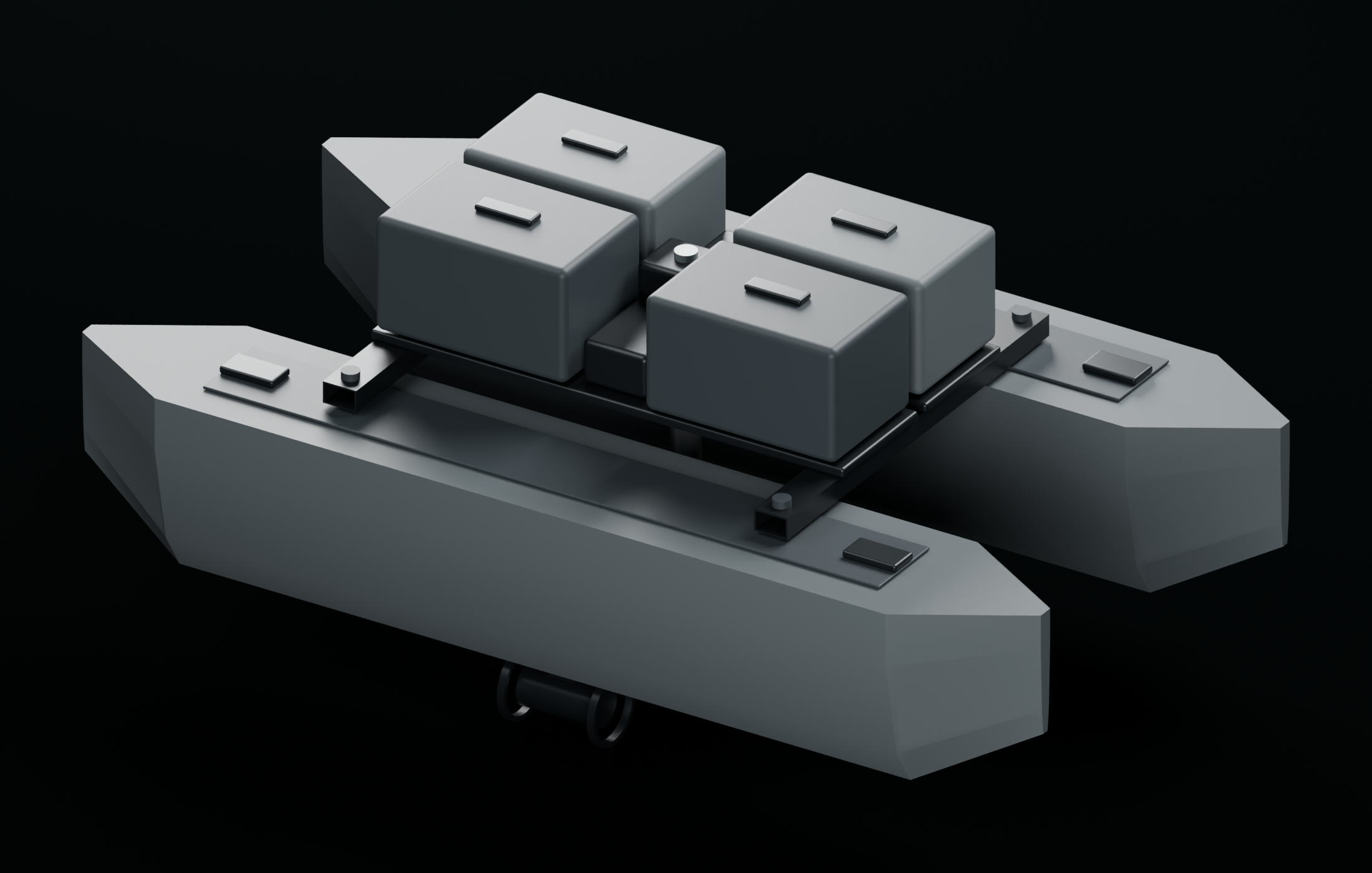
Still-water concept study. Prototype testing is the next stage.
01 / The design brief
Collect samples.
Keep the platform manageable.
The concept is a compact civil platform for environmental measurements in sheltered fresh water. Two hulls support a removable payload, with separate modules for transport and servicing.
The original mission carries 8 kg of instruments. The sampling mission carries four 10-litre water samples, plus four containers budgeted at 1 kg each: a 44 kg payload.
The internal brief sets a 90 mm freeboard target, a 950 mm maximum assembled width and transport limits for each separate module. These are project assumptions chosen for the concept comparison.
02 / Check the loaded condition
Test the mission against the reserve target.
The original concept carries an 8 kg instrument package at an estimated total mass of 35 kg. The sampling brief instead allocates 44 kg to water and containers, taking estimated total mass to 71 kg and calculated freeboard to 88.9 mm.
That result sits 1.1 mm below the internal 90 mm target. With unmeasured component weights, it is a borderline concept estimate. The +15% mass sensitivity reaches approximately 69.0 mm, establishing the reserve range that the revised geometry must address.
03 / Balance the constraints
Recover reserve within the transport width.
The revised concept widens each hull from 190 to 250 mm, deepens it from 260 to 300 mm and increases their centre spacing from 600 to 650 mm. Overall width becomes 900 mm, retaining 50 mm within the stated transport-width limit.
The 44 kg payload is unchanged. Estimated total mass rises by 3.4 kg to 74.4 kg. Calculated freeboard becomes 152.9 mm, or 135.6 mm in the +15% total-mass sensitivity case.
| Configuration | Assumed mass | Freeboard | Initial GM* |
|---|---|---|---|
| Original / instruments | 35.0 kg | 162.5 mm | 0.984 m |
| Original / samples | 71.0 kg | 88.9 mm | 0.431 m |
| Revised / samples | 74.4 kg | 152.9 mm | 0.638 m |
| Revised / +15% mass | 85.56 kg | 135.6 mm | 0.554 m |
*Transverse initial metacentric height, corrected for the four separate liquid free surfaces. All values are still-water concept calculations.
04 / The decision record
A design change.
A traceable consequence.
Each mission and mass assumption belongs to a specific project revision. The calculation reads the hull geometry and mass budget for that revision.
When the mission changes, the earlier calculation remains part of the history. It is no longer accepted as evidence for the new configuration. A new calculation records the consequences of the design change.
The comparison makes the trade visible: more payload requires more displacement reserve, with a wider and heavier platform.
Calculation method and independent checks
FreeCAD's geometry kernel finds the water level at which submerged volume balances the assumed total mass. The calculation uses the submerged centre of volume and waterplane moments for initial transverse stability, then corrects for the free surfaces of four separate tanks. Masses and centres of gravity are budgeted independently of the rendered exterior volumes.
A separate geometric integration confirmed the still-water results in 42 checks. The project adapter underwent a separate 92-check audit covering real calculations, stale results, changed source bytes and altered receipts. The present evidence demonstrates a coherent geometry-to-calculation workflow across the three selected configurations; it does not measure a professional time advantage or provide physical validation. The comparison does not search an exhaustive design space.
Prototype tests and material limits
The next useful prototype would let us weigh the modules and measure the loaded waterline. That provides a direct comparison with the mass budget and predicted freeboard.
A controlled small-angle stability measurement would then test the initial-stability estimate. Structure, watertightness, connections, asymmetric loading and behaviour in waves require their own work before an operational craft is claimed.
The design's removable modules help transport. They do not make a loaded 74.4 kg platform a one-person lifting task.
Geometry and image provenance
LITTORAL is an original Archeion concept. Its native FreeCAD files, exported geometry, calculation meshes and Blender renderings come from the same design data. The visible studio lighting and floor are presentation elements. No photograph of a manufactured prototype is used.
The +15% total-mass scenario retains the assumed centre of gravity. Liquid containers are treated as separate, symmetrical tanks; large-angle and wave behaviour are not represented by the initial-stability result.